


Get monthly updates and savvy success stories. Straight to your inbox.
Self Assessment has a way of sitting on your to-do list for months. You know it needs doing, but between work, family and everything else, it rarely feels like the most pressing task.
Then January arrives, and you are looking for a statement, questioning an expense and trying to work out whether you have put enough money aside.
Getting your return prepared earlier gives you something useful: clarity. You can find missing information, understand your tax position and plan for payment while you still have time.
First, which tax year are we talking about?
The return currently due covers the 2025/26 tax year: 6 April 2025 to 5 April 2026.
This matters because a UK tax year does not follow the calendar year. When gathering information, you need records relating to that period.
For most people filing online, the deadline is 31 January 2027. That is also the usual deadline for paying any outstanding tax for the year.
You do not have to wait until January to submit. Getting your return prepared earlier normally gives you more time to plan for payment without bringing the payment deadline forward.
In this article, we share five practical checks to help you get ready, understand potential surprises and decide where professional support could save you time.

1. Make a list of where your income came from
Start with a simple question: how did you earn or receive money during the tax year?
Perhaps you were employed and did some freelance work. You might have received rent from a property, dividends from your company or interest on savings.
Before looking for documents, write down the income sources relevant to you. This gives you a checklist to work through and helps you spot anything you might otherwise forget.
Depending on your circumstances, you may need:
- Employment records: Your P60 or P45, showing pay and tax deducted, plus details of any taxable benefits.
- Self-employment records: Information about your business income and expenses.
- Property records: Rental income and details of relevant property costs.
- Savings and investment records: Interest statements, dividend vouchers or information about assets you sold.
- Other supporting information: Details of overseas income, pension contributions or Gift Aid donations, where relevant.
You will not necessarily need everything on this list. The documents depend on your circumstances.
The useful first step is to put what you have in one place and note anything missing.
2. Check your expenses before working out your profit
If you are self-employed, you are generally taxed on your taxable profit, rather than all the money your business receives.
In simple terms, taxable profit is your business income minus allowable expenses, with any other relevant tax adjustments.
For example, if your business receives £30,000 and has £5,000 of allowable expenses, that leaves £25,000 of profit before any further adjustments. Your eventual tax bill also depends on your wider circumstances.
This is why expenses deserve attention. Missing an eligible cost could mean reporting more profit than you should. Claiming a personal purchase as a business expense could make your return incorrect.
HMRC allows qualifying business costs, but personal spending does not become deductible simply because you paid for it through a business account. If something is used for both work and personal purposes, only the qualifying business share may be allowable.
Think about costs such as:
- Software used for your work.
- Business insurance.
- Materials and supplies.
- Relevant business travel.
- The business portion of certain phone or internet costs.
These are things to check, rather than expenses everyone can automatically claim.
If you are unsure about a cost, keep the receipt and ask. You do not need to guess or leave it out without checking.
3. Understand what you might need to pay in January
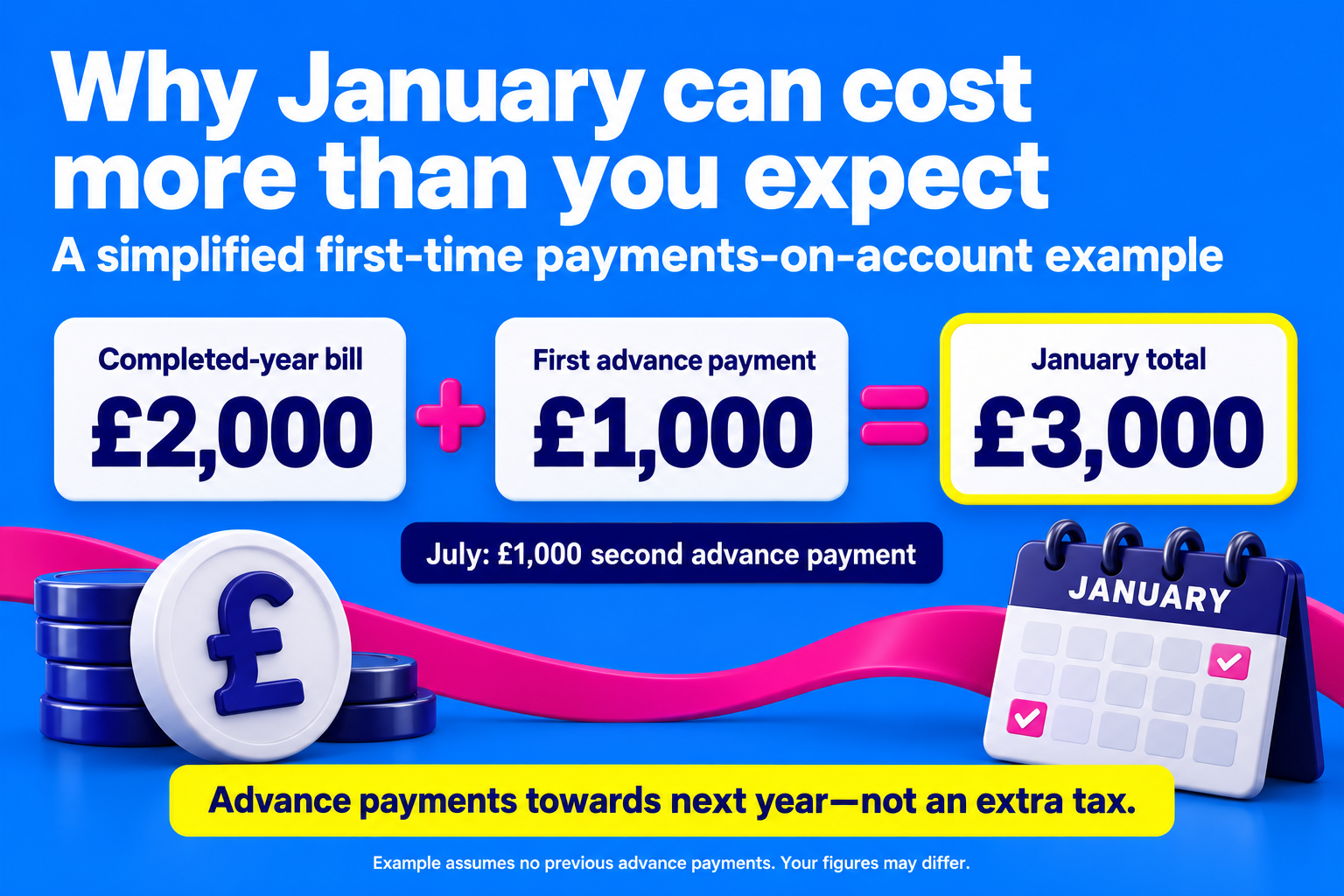
Your tax calculation tells you what you owe for the completed tax year. But the amount payable in January can sometimes include something extra: payments on account.
These are advance payments towards the following year’s tax bill.
They are not an additional tax. They bring forward part of the payment for the next year, usually in two instalments: one in January and another in July.
Payments on account generally apply unless your relevant previous tax bill was below £1,000, or more than 80% of your tax was collected outside Self Assessment, such as through your wages.
Here is a simplified example.
Suppose you are making payments on account for the first time. Your completed-year bill is £2,000, all of it counts towards the calculation, and you have not already made any advance payments.
You could need to pay:
- £2,000 in January for the completed tax year.
- Another £1,000 that January as the first advance payment for the following year.
- £1,000 in July as the second advance payment.
That would make the January payment £3,000, even though the completed-year bill was £2,000.
Your own figures may be different. The important thing is to check whether payments on account apply before deciding how much money to set aside.
4. Give yourself time to plan for the bill
Preparing your return earlier helps you replace “I think I have enough saved” with a clearer picture.
Once you know the amount due, compare it with the money you have reserved for tax.
If there is a gap, knowing sooner gives you more time to plan. If you have enough set aside, you can stop wondering about it.
Before putting the return aside, make sure you understand:
- How much you need to pay.
- When each payment is due.
- Whether payments on account are included.
- Whether earlier payments have already reduced the balance.
If someone prepares your return, ask them to explain these amounts clearly. You should understand the result, even if you did not do the calculations yourself.
5. Decide whether you want to prepare the return yourself
You do not have to use an accountant for Self Assessment.
However, professional help can be useful when you are unsure what to declare, have several income sources or would rather spend your time elsewhere.
An accountant can prepare the return from your records, consider relevant expenses and reliefs, and explain your tax position. They may also spot missing information or figures that need checking.
You still need to provide complete information and review the finished return. But you have someone to work through the preparation with you, rather than trying to answer every question alone.
The benefit is not always a lower tax bill. It can be time saved, fewer unanswered questions and a clearer understanding of what you owe.
How Addition helps you get your return sorted
Here is how it works:
- Tell us about your circumstances. Answer questions about your income and tax situation.
- Upload your documents securely. Provide the information needed to prepare your return.
- An Addition accountant prepares it. We review your information and consider eligible expenses and allowances.
- Review and approve your return. You can see your completed return and tax position before submission.
- We file it with HMRC. Once you approve it, we handle the submission.
You can track progress through Addition and contact the team during preparation. More complex circumstances may require additional support, which we discuss with you before proceeding.
Start with what you have
You do not need to understand every tax rule before taking the first step.
Make a list of your income sources, gather the documents you can find and write down your questions. That gives you a starting point, whether you prepare the return yourself or ask for help.
Get your Self Assessment started with Addition.
Have a question first? Contact our team or book a call to discuss your circumstances.

