



Get monthly updates and savvy success stories. Straight to your inbox.
No, you do not have to use an accountant for Self Assessment.
You can prepare and submit your own return. However, paying someone can be worthwhile if your tax affairs are complicated, you are unsure what to include or you would rather have professional support. HMRC recognises that using a tax agent can be particularly helpful for people with complex circumstances.
The decision comes down to three things: how straightforward your return is, how confident you feel completing it and how much time you can give it.
In this article, we explain when doing your own Self Assessment may make sense, when an accountant can help and what to check before paying someone to prepare your return.
When can you do your own Self Assessment?
Completing your own return may be a practical option if your circumstances are straightforward and you understand the requirements.
You should feel comfortable gathering your records, identifying the income you need to report and checking how relevant expenses or reliefs apply.
Doing it yourself may suit you if:
- Your income is straightforward: You have a small number of clearly documented income sources.
- You understand the figures: You know what the amounts represent and where they belong.
- You have time to check: You can work through the return without rushing.
A straightforward return still deserves careful attention. Feeling confident using an online form is different from understanding the information it asks you to report.
When is it worth paying an accountant for Self Assessment?

An accountant is worth considering when uncertainty, complexity or the time involved makes preparing your own return difficult.
You do not need an unusually large income to benefit from support. A relatively modest amount of income can still raise questions about expenses, property or overseas tax matters.
You have several sources of income
Combining employment with freelance work, rental income, dividends or other earnings can make a return harder to navigate.
For example, someone with a salary and a growing freelance business may need to organise employment documents alongside business income and expenses.
An accountant can help bring that information together. Tell them about every income source at the outset so they can confirm the scope of the work.
You are unsure about expenses and reliefs
Knowing that you spent money does not automatically tell you whether it qualifies for tax relief.
Questions often arise when something has both business and personal use, or when you are unsure which records support a claim.
Professional help can be useful if you find yourself guessing. The aim should be to apply the rules correctly and claim what you are entitled to, based on your circumstances.
Your circumstances have changed
A return that was manageable last year may need more attention this year.
Starting self-employment, receiving overseas income or selling an investment can introduce unfamiliar questions. Previous experience completing a return does not necessarily resolve those new issues.
Explain significant changes before asking for a quote. Some matters may require specialist advice beyond a standard filing service.
You keep putting it off
Sometimes the main difficulty is finding the time and headspace.
If preparing your return repeatedly slips down your list, paying someone may help you move it forward. You will still need to supply documents and answer questions, but you can hand over the preparation work.
Compare the fee with the hours you expect to spend, the disruption involved and the value of having someone explain the result.
What are the benefits of hiring an accountant for Self Assessment?
Hiring an accountant can save you time, help you understand your tax position and give you confidence that a professional has reviewed your return.
The main benefits include:
- Less time spent on tax admin: You still provide the records, but your accountant handles preparing the return and works through questions with you.
- Help identifying eligible claims: An accountant can consider expenses, allowances and reliefs you may have overlooked, while checking whether they apply to your circumstances.
- A clearer understanding of your tax bill: Having someone explain the calculation helps you understand what you owe and plan for payment.
- Support with unfamiliar situations: If your income or circumstances have changed, an accountant can help identify what needs attention and whether specialist advice is required.
- An opportunity to catch mistakes: Professional review can help spot missing information or inconsistencies before submission, although it cannot guarantee an error-free return.
- Less uncertainty: Instead of trying to interpret every requirement alone, you have someone to explain the relevant points and answer questions within the agreed service.
The value is not always a lower tax bill. It can also be the hours you save and the reassurance of understanding what is being submitted.
What does an accountant actually do?

The exact service depends on what you agree. A Self Assessment engagement may include:
- Reviewing your information: Checking the records and details you provide.
- Preparing the return: Completing the relevant sections for your circumstances.
- Considering eligible claims: Reviewing potentially applicable expenses, allowances and reliefs.
- Calculating your tax position: Explaining the liability arising from the return.
- Answering preparation questions: Helping resolve queries within the agreed scope.
- Submitting to HMRC: Filing after you have reviewed and approved the completed return.
Bookkeeping, specialist tax planning, amendments and HMRC enquiry support may be separate services. Ask what is included before proceeding.
If you want someone to prepare and file your return, explore Addition’s Self Assessment service.
Will an accountant reduce your tax bill?
An accountant may identify eligible claims you have overlooked, however a lower tax bill is not guaranteed.
You may already have calculated everything correctly. In that case, the value of professional help may be time saved, clearer explanations and greater confidence in the preparation process.
Avoid judging a service solely on promises of tax savings. A useful accountant should explain the treatment of your income and claims, rather than encourage you to expect a particular refund.
The fee should make sense even if your final tax bill stays the same.
Are you still responsible if an accountant files your return?
Yes. You remain responsible for your own tax affairs when you use an accountant or tax agent. HMRC makes this clear in its guidance on choosing a tax agent.
That means supplying complete information and checking the finished return.
Before approving it, review the income figures, expenses and other entries. Ask about anything unexpected, including claims you do not recognise.
Your accountant should explain how to authorise them to deal with HMRC. That authorisation allows them to act within the permissions you give, including submitting your Self Assessment where applicable.
What should you ask before choosing an accountant?
A clear conversation before you commit can prevent confusion later.
Ask:
- Does your service cover my circumstances? Mention all income sources and any unusual transactions.
- What is the total fee? Check applicable VAT and anything charged separately.
- Will you prepare and submit the return? Confirm both stages are included.
- What support can I access? Ask how questions are handled during preparation.
- Will I see the return before submission? Make sure you can review the figures.
- What do you need from me? Request a document checklist and timetable.
If your situation needs specialist expertise, ask whether the provider offers that support.
How Addition can help with Self Assessment
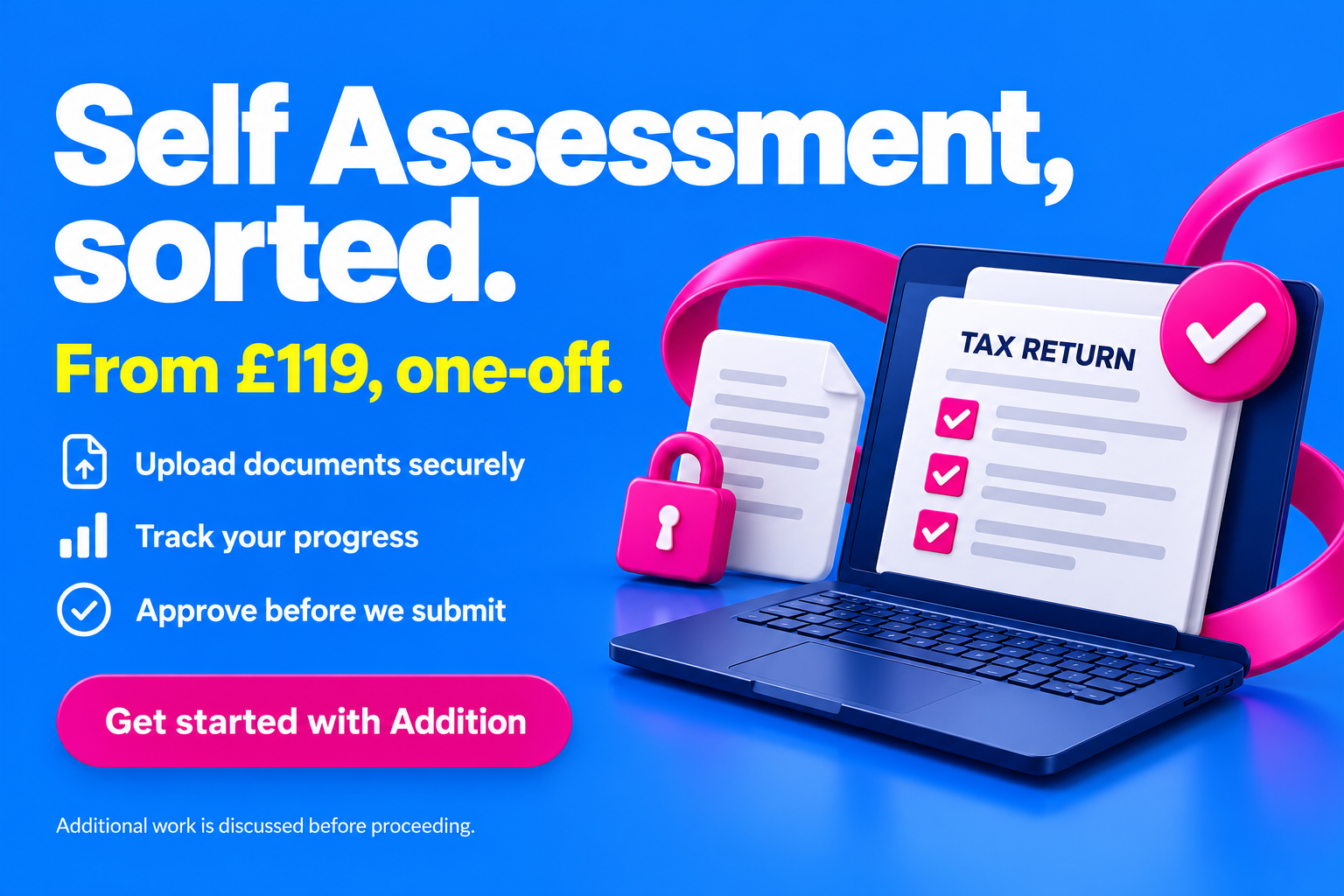
Addition’s Self Assessment service starts from £119 as a one-off payment.
You provide your details and upload documents securely. An Addition accountant reviews the information and prepares your return, including consideration of eligible expenses and allowances.
You can track progress, review your tax position and approve the completed return through Addition before we submit it to HMRC.
More complex tax affairs may require additional support, which we discuss with you before proceeding.
Frequently asked questions
Do I need an accountant for my first Self Assessment?
No. Being a first-time filer does not make an accountant compulsory. Support may still be useful if you are unfamiliar with the process or unsure how to report your income.
Can I use an accountant just for my tax return?
Yes, where the provider offers a one-off service. Check whether the fee covers your return without an ongoing subscription.
Does an accountant need my records?
Yes. Professional preparation still relies on the information you supply. Organising your documents early helps the accountant understand your circumstances and identify missing details.
When should I contact an accountant?
Give yourself enough time to gather records, answer questions and review the return. For most online 2025/26 returns, the filing deadline is 31 January 2027. Check HMRC’s current deadlines for your circumstances.
Get the support that suits your return
You may be comfortable completing Self Assessment yourself. If you are unsure about the figures, short on time or facing unfamiliar tax questions, professional preparation can be a useful investment.
Start your Self Assessment with Addition, or contact our team to ask whether the service suits your circumstances.
Prefer to talk first? Book a call with Addition to discuss the support you need.

