


Get monthly updates and savvy success stories. Straight to your inbox.
Announced on 28 October 2026, the UK Autumn Budget 2026 brings business rates support for eligible high street businesses, a higher trading allowance and changes to the tax paid on property income, savings and business sales.
Several important measures begin in April 2027, giving business owners time to work through the impact before they take effect.
If you run a business, work for yourself or earn rental income, then you're probably wondering if you will you have more money left over, or should you put more aside?
The answer depends on how you earn your income, where your business operates and which reliefs you qualify for.
In this article, we explain the announcements most relevant to small businesses, founders and individuals, and what to check next.
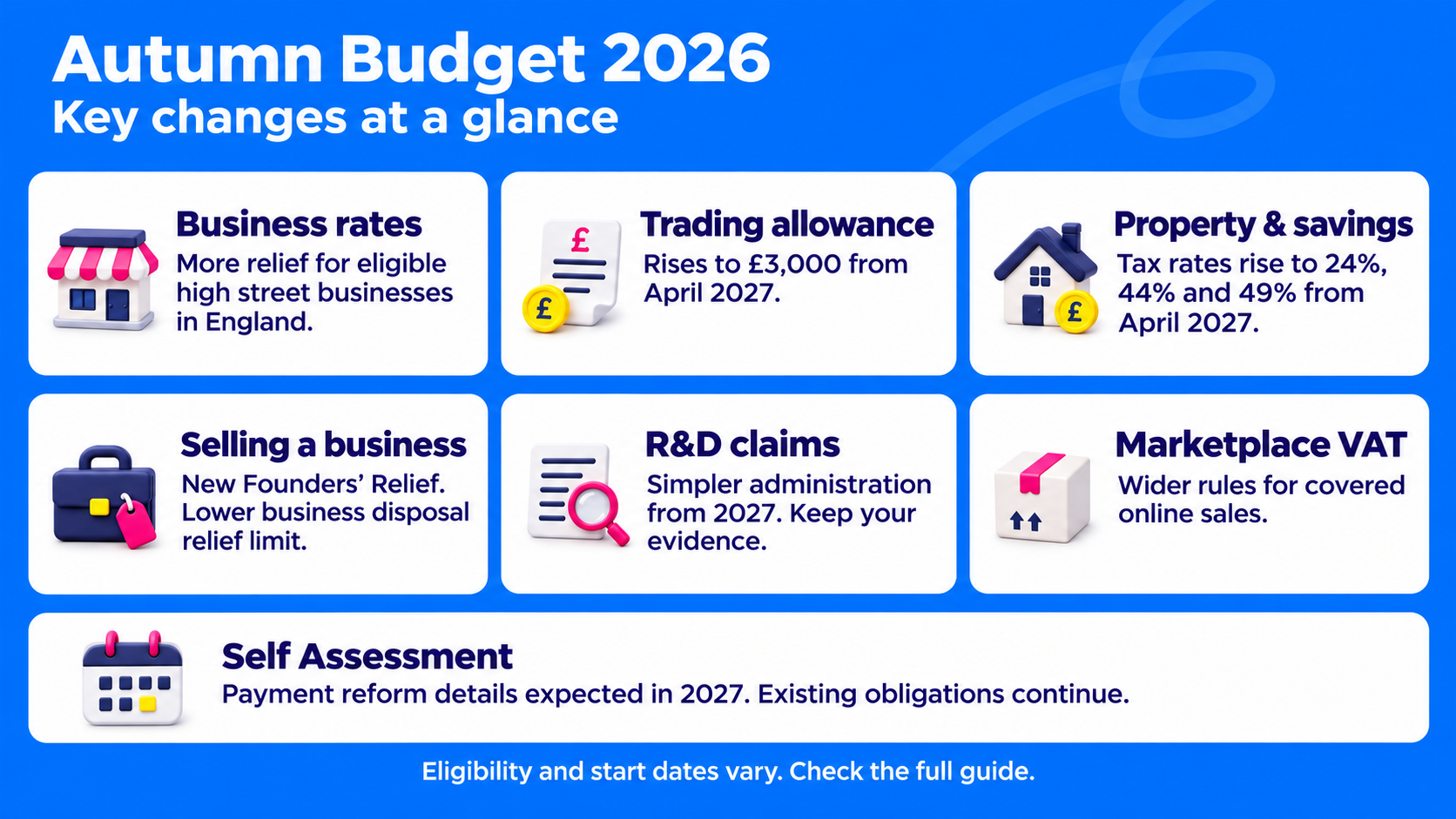
- Business rates: Higher relief thresholds apply to qualifying retail, hospitality and leisure properties in England from 1 April 2027. Check your rateable value and eligibility.
- Trading allowance: The allowance rises to £3,000 from 6 April 2027 for qualifying trading or miscellaneous income. Check your gross income and whether you still need to submit a return.
- Property and savings income: Announced tax rates of 24%, 44% and 49% apply from 6 April 2027. Review your allowances, applicable rates and how much you set aside for tax.
- Selling a business: Founders’ Relief and a lower Business Asset Disposal Relief limit take effect from 6 April 2027. Check which relief applies and the final eligibility rules.
- R&D claims: Administrative changes begin from 1 April 2027, with further changes in autumn 2027. Keep checking claim requirements and gathering supporting evidence.
- Marketplace VAT: Wider liability rules affect online marketplaces and sellers within the announced scope. Check implementation guidance, covered sales, platform records and VAT reconciliation.
- Self Assessment payments: Further details on payment reform are expected in 2027. Continue planning for your existing payment obligations.
These are selected announcements. The sections below explain their scope and link to the relevant government guidance.
Will small businesses pay less in business rates after Budget 2026?
From 1 April 2027, some small businesses in England will pay less in business rates because the Small Business Rate Relief thresholds for qualifying retail, hospitality and leisure properties are increasing. The rateable value threshold for full relief will rise to £18,000, with tapered relief extending to £21,000.
Eligible pubs, social clubs and live music venues will also receive increased relief, rising from 15% to 35%. The largest live music venues are excluded from that increase. Other qualifying retail, hospitality and leisure properties will receive protection intended to cap bill increases at inflation for two years, subject to exceptions.
For a café, shop or venue, this could make a useful difference to overheads. Check your property's rateable value and eligibility before putting a saving into your forecast. These announcements concern England; businesses elsewhere in the UK should check the arrangements applying locally.
Source: HM Treasury, Budget 2026.
When does the trading allowance increase to £3,000?
The trading allowance will increase from £1,000 to £3,000 from the 2027/28 tax year. HMRC says the associated Income Tax Self Assessment reporting threshold will also rise to £3,000.
This matters particularly if you earn modest amounts from freelance work, occasional services or another small trading activity alongside your main income.
Timing matters here. The increase starts on 6 April 2027, so it should not be applied to earlier tax years. You should also check whether your income qualifies and whether another reason requires you to submit a return.
Keep recording what you earn, even if you expect to fall below the new threshold. A few extra jobs can change your position, and reliable records make that easier to spot.
Source: HMRC, increasing the trading allowance.
What are the property and savings income tax rates from April 2027?
From 6 April 2027, the announced basic, higher and additional rates for property income and savings income will be 24%, 44% and 49% respectively.
For landlords and people with taxable savings interest, this is a reason to revisit how much they reserve for tax. The amount payable will depend on their taxable income and any relevant allowances or reliefs.
Start with an updated estimate of income, then calculate the likely liability using the applicable rules. Rental receipts alone will not tell you what tax you owe. If you need help preparing your return, see Addition’s Self Assessment service.
If rental income helps cover your household costs, look at what remains after expenses and tax. That gives you a more useful spending figure than the amount arriving in your bank account each month.
Example: estimating a tax reserve
Suppose £10,000 of an individual's taxable property income falls entirely within the announced 24% basic property rate. Tax on that slice would be £2,400: £10,000 × 24%. Spread over 12 months, that is a £200 monthly reserve.
This simplified illustration assumes allowances have already been accounted for and no further relief or tax credit applies. Your actual bill and payment dates depend on your full circumstances.
Source: HMRC, property and savings income tax rates.
How does Budget 2026 affect tax when selling a business?
From 6 April 2027, the announced changes introduce Founders' Relief and reduce the Business Asset Disposal Relief lifetime limit. Owners considering a sale need to check both measures.
The government has announced Founders' Relief, offering a 10% Capital Gains Tax rate on qualifying share disposals from 6 April 2027, with a £10 million lifetime limit. It targets founders and early investors in high-growth, innovative companies. A technical consultation on its practical application remains open until 30 November 2026.
Separately, the Business Asset Disposal Relief lifetime limit will fall from £1 million to £500,000 for qualifying disposals from 6 April 2027.
Being a business owner does not automatically mean you qualify for the new relief. If you are considering a sale, succession or investment, check which rules apply to your circumstances before agreeing a timetable. The headline rate is only useful once eligibility is established.
Sources: HMRC, Founders' Relief and Business Asset Disposal Relief.
Will claiming R&D tax relief become simpler?
The government plans to remove the R&D claim notification form requirement for claims made on or after 1 April 2027. It also plans to simplify the additional information form from autumn 2027.
These changes should reduce some of the administration involved in making a claim. They do not, by themselves, establish that a project qualifies for relief.
If your company carries out potentially qualifying research and development, continue gathering evidence as the work happens. Record the technical challenges, the work undertaken and the associated costs. That is far easier than trying to reconstruct everything when the accounts are due. Read about Addition’s R&D claim support if you need help assessing activity or preparing the evidence.
Source: HMRC, improving the R&D claims process.
How does Budget 2026 affect online sellers’ VAT?
The government has confirmed an extension of online marketplace VAT liability rules to certain sales by UK businesses where the goods are in the UK when sold.
HMRC says marketplaces will collect VAT on covered sales by UK VAT-registered businesses and other UK businesses reaching a minimum annual sales threshold of £90,000 per platform. Personal sales, second-hand goods and business-to-business transactions are excluded from the announced rules.
If you sell through marketplaces, review the implementation guidance before changing your accounting. You will need to understand how platform statements, VAT records and payouts fit together, particularly if you also sell through your own website. Addition’s finance support for e-commerce businesses covers bookkeeping, VAT and reporting across sales channels.
Source: HMRC, online marketplace VAT liability.
Does Budget 2026 change Self Assessment payment dates?
Budget 2026 does not provide a complete replacement timetable for Self Assessment payments. The government has published its response to the consultation on more timely Income Tax Self Assessment payments. It says the arrangements will offer greater choice and flexibility, with further details to follow next year.
Follow developments and check the eventual rules against your circumstances before changing your forecast.
Keep preparing for the payments already due under your existing obligations. Ask your accountant to distinguish any future payment changes from the liability you are currently budgeting for, so an announcement about reform does not leave you short of cash when a bill arrives.
Source: HMRC, timely Self Assessment payments.
What should you do after the Autumn Budget?
Start with the changes that actually touch your finances. A landlord, a restaurant owner and a technology founder will have different priorities.
Make a short list of relevant measures and their start dates. Then update your forecast using your own figures: expected sales, operating costs, planned spending and tax payments. Keep assumptions visible so you can revise them when further guidance arrives.
For example, a potential business rates saving might help fund a planned purchase. A higher personal tax bill might mean increasing your monthly tax reserve. Neither decision needs to wait until the payment is due.
At Addition, our finance managers help you understand what changes mean for your business and plan around the numbers. If you are unsure which announcements affect you, speak to the Addition Finance Team. We can help you work out what needs attention now and prepare for the year ahead.


